The Challenge
Kooness is a leading online marketplace for contemporary art, connecting art lovers, collectors and galleries from around the world.
The platform provides galleries with a digital presence through which they can showcase and sell artworks to collectors internationally. Its multilingual platform supports galleries, artists and administrators, while an integrated Content Management System allows different user roles to manage content and artwork information.
As the platform evolved, Kooness introduced different membership plans designed to provide galleries with progressively more capabilities.
The platform was attracting users.
But there was a business challenge.
Platform growth was not translating into the level of paid membership adoption Kooness expected.
The number of galleries and users was increasing, yet relatively few were moving towards higher-value subscription plans.
For the Kooness team, the question became:
How could the platform provide enough additional value to encourage galleries to engage more deeply and adopt higher-value services?
Looking Beyond the Development Brief
Rather than treating the challenge simply as a request to add more features, our team took a step back.
We wanted to understand what was actually happening across the platform.
Our engineers developed custom database queries to generate datasets that could reveal the behaviour of galleries and users.
We analysed:
- Gallery subscription activity
- User activity
- Paid versus non-paid membership
- Gallery engagement
- Usage patterns
- Existing platform functionality
- Potential gaps in the current offering
The analysis revealed an important opportunity.
Although thousands of galleries had subscribed to the platform, only a relatively small proportion were actively engaging with it.
In one analysis, approximately 12.75% of subscribed galleries were active, and among the active subscriber group, approximately 79% were paid members.
This helped shift the conversation.
The challenge was not simply about attracting more galleries.
It was about creating more meaningful value for the galleries already using the platform.
Turning Data Into a Product Opportunity
The next question was:
What would actually make galleries want to use more of the Kooness platform?
We did not want to propose another collection of features simply because they were technically possible.
The idea needed to work from three perspectives:
For galleries:
It had to solve real operational problems and provide practical value.
For Kooness:
It had to support the company's business objectives and create a stronger platform proposition.
For the market:
It had to provide capabilities that could differentiate Kooness from competing platforms.
Our team therefore went beyond the existing product.
We analysed competing platforms, studied how similar businesses positioned their services, reviewed their functionality and looked at how galleries could benefit from a more complete digital workflow.
The conclusion was clear.
The existing membership features were not providing enough additional value to create a compelling reason for galleries to move towards higher-level plans.
The opportunity was not simply to add more CMS functionality.
It was to give galleries a system that could become part of their day-to-day business operations.
That led us to the idea of a dedicated CRM platform for Kooness galleries.
From CMS to CRM
The existing Kooness CMS was primarily designed around managing website content and platform information.
The new requirement was fundamentally different.
Galleries needed more than content management.
They needed a place where they could manage relationships, artworks, artists, contacts, sales-related information and operational activities.
The vision was to introduce a dedicated CRM experience while preserving the existing CMS for administrative purposes.
This created a significant architectural and product challenge.
We needed to introduce a new business system without disrupting the platform that was already serving Kooness users.
The Challenges
1. Introducing a CRM Without Disrupting the Existing CMS
The existing CMS remained an important part of the Kooness platform and was required for administrative activities.
The new CRM therefore needed to coexist with the existing system rather than simply replace it.
Our objective was to create a clear separation between:
CMS
Managing platform and website content.
CRM
Helping galleries manage their business relationships and operational activities.
This required careful analysis of the existing architecture, user roles, permissions and data structures before introducing the new functionality.
2. A Feature-Rich Product Within a Tight Timeline
Kooness wanted to introduce the new CRM within a very short timeframe.
The scope was significant.
The system needed to provide galleries with multiple capabilities while maintaining the quality and usability expected from the existing platform.
The challenge was therefore not simply developing quickly.
It was deciding:
What needs to be delivered first?
What can be delivered in phases?
How do we protect the existing platform?
And how do we maintain quality while moving quickly?
Our team worked closely with the Kooness stakeholders to establish priorities, break down the requirements and align the development effort with the available timeframe.
3. Turning Business Ideas Into Technical Features
Kooness had a clear understanding of the business problems they wanted to solve.
However, translating those ideas into software requirements was often more complex.
A business idea might sound simple at first, but implementing it could involve:
- Data relationships
- User permissions
- Existing CMS functionality
- Workflow design
- Reporting
- Database changes
- User experience
- Integration with existing platform features
Our role was therefore not simply to receive requirements and write code.
We worked with the Kooness team to understand the underlying business objective and then translate it into practical technical solutions.
Our Approach
Before development began, we analysed the existing system architecture, the proposed CRM requirements, the existing user experience and the technical possibilities for extending the platform.
We then established a clear delivery approach.
Understand
We worked closely with the Kooness team to understand the business objectives behind the new CRM.
Analyse
We reviewed the existing platform architecture, data structures and functionality to identify how the new system could be introduced safely.
Prioritise
With a significant feature set and limited time, we agreed on priorities and aligned development activities with the most important business requirements.
Design
The CRM was designed as a new service layer for galleries while preserving the existing CMS functionality required by Kooness administrators.
Develop
Using an agile development process, our engineers implemented the new functionality incrementally and continuously aligned the solution with client feedback.
Validate
The team continuously reviewed functionality against the original business objectives, ensuring that technical implementation remained aligned with the intended user experience.
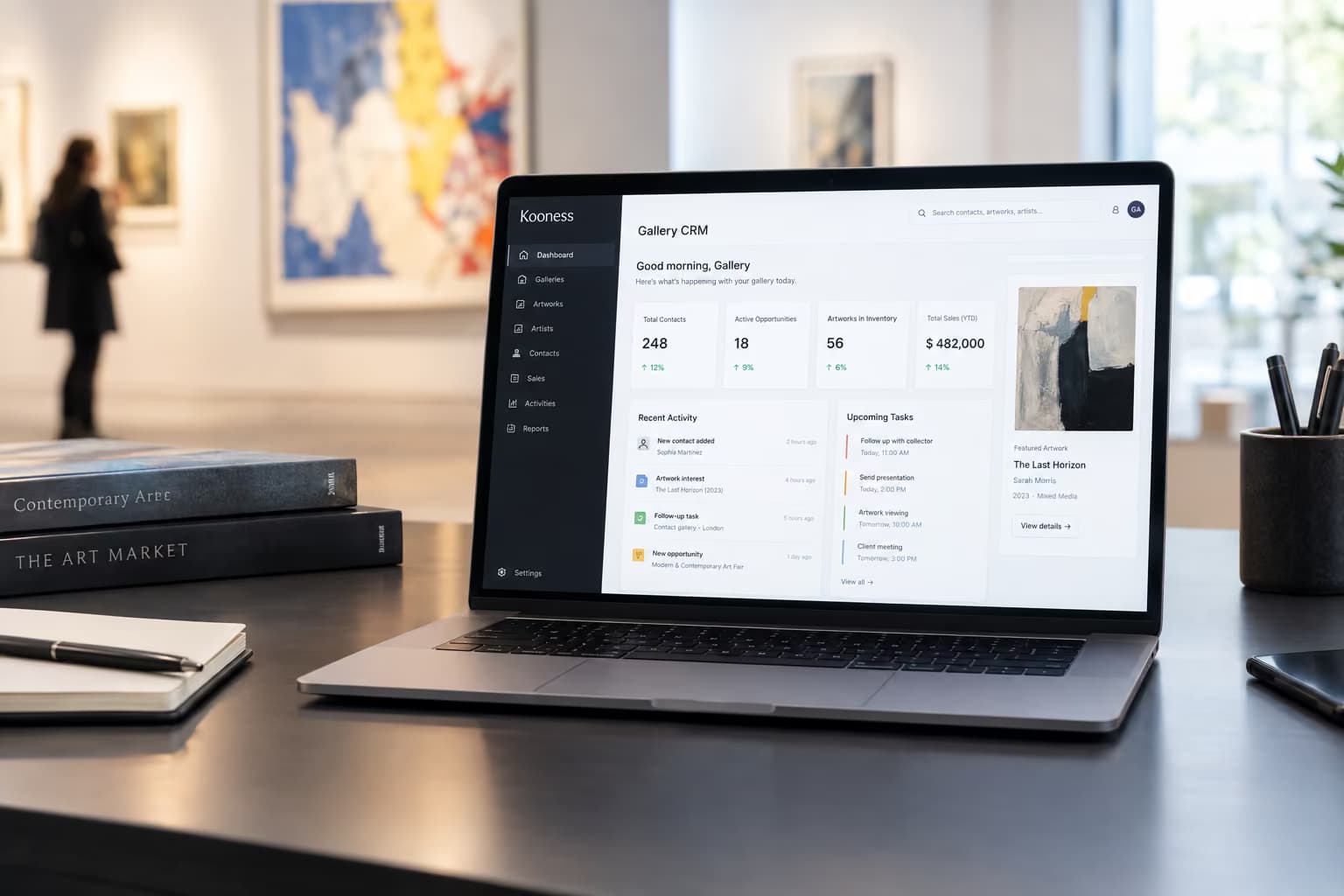
The Kooness Gallery CRM
The new CRM gave galleries a more comprehensive environment for managing their activities within the Kooness ecosystem.
The platform brought together functionality around areas such as:
- Artwork management
- Artist management
- Gallery contacts
- Customer and relationship management
- Sales-related activities
- Reporting
- Activity management
- Gallery information
- Operational data
The CRM also incorporated relevant content-management capabilities, reducing the need for galleries to work across disconnected systems.
The result was a platform designed to become more than a place to publish artworks.
It became a more complete digital workspace for galleries operating through Kooness.
Building at Speed Without Losing Alignment
The tight delivery timeline required strong collaboration between the Kooness and DigitalBee Labs teams.
We agreed on the delivery timeframe, established priorities and broke the work into manageable development activities.
The project followed an agile process, allowing the team to continuously review progress, clarify requirements and adapt implementation where necessary.
This was particularly important because many requirements originated from business needs rather than technical specifications.
Instead of treating changing requirements as obstacles, we used continuous communication to ensure that the product continued to reflect the business vision.
The close collaboration between both teams allowed us to move quickly while maintaining alignment.
The Result
The introduction of the CRM expanded the role of the Kooness platform for its gallery users.
Instead of focusing only on publishing and managing online content, galleries gained access to a broader set of tools for managing their activities and relationships.
The project also demonstrated the value of approaching a development engagement from a business perspective.
Rather than simply implementing the original feature request, DigitalBee Labs helped Kooness investigate why the existing membership proposition was not producing the desired level of engagement and what type of additional value could address the gap.
Key outcomes
Business-led product development
The CRM concept was developed from analysis of user activity, business objectives and competitive functionality.
A broader value proposition for galleries
The platform expanded beyond traditional CMS functionality towards a more complete gallery-management experience.
Integrated with the existing ecosystem
The CRM was introduced while preserving the existing CMS capabilities required by Kooness.
Agile delivery
A feature-rich product was developed within a challenging timeframe through prioritisation and close collaboration.
Stronger platform capabilities
Galleries gained additional tools for managing artworks, artists, contacts, activities and reporting.
More Than Development
One of the most important aspects of the Kooness engagement was the role DigitalBee Labs played beyond software development.
The original challenge was a business-growth question.
The answer required more than engineering.
It required us to:
Analyse the data.
Understand user behaviour.
Study the competition.
Challenge assumptions.
Identify product gaps.
Translate business ideas into technology.
Build and deliver the solution.
This is the kind of engagement we believe creates lasting value.
A development team can build the feature requested by a client.
A technology partner should also be willing to ask:
Is this actually solving the business problem?
Client Perspective
The Kooness team recognised this broader contribution in their feedback:
“Having worked with DigitalBee Labs for a whole year on an almost daily basis, I can assure that not only their services, but the personal value that they add to a work environment is truly incredible. They have brought to life every idea we have developed and assisted us beyond what we had expected. Moreover, their involvement has been an educational journey for our team, imparting invaluable development and tech-related knowledge. This has been priceless for our team development.”
For us, the most meaningful part of this feedback is not simply the recognition of technical delivery.
It reflects the way we approach collaboration.
We aim to work alongside our clients, contribute technical thinking, challenge ideas when necessary and help turn business concepts into working products.
The DigitalBee Labs Difference
The Kooness project illustrates a principle that sits at the heart of our approach:
Technology should serve the business, not exist separately from it.
When Kooness faced a challenge with membership growth, we did not immediately respond with another list of features.
We investigated the data.
We looked at how the platform was being used.
We examined the competitive landscape.
We identified where the existing proposition could be strengthened.
And then we helped transform that insight into a new product capability.
That is the difference between delivering software and engineering solutions around business objectives.
From Business Challenge to Digital Product
The Kooness journey began with a simple question:
How can we create more value for galleries and support the next stage of platform growth?
The answer became a new CRM experience that expanded what galleries could do within the Kooness ecosystem.
For DigitalBee Labs, the project reinforced something we see across technology engagements:
The best solutions often emerge when engineering teams understand the business problem deeply enough to look beyond the original request.
We do not simply build what is asked.
We listen, investigate, challenge, design and engineer.
Because when technology is aligned with the business, a feature becomes more than functionality.
It becomes an opportunity for growth.