The Challenge
InfoJobs is one of Europe's established career platforms, connecting professionals with companies and publishing thousands of new job opportunities every week.
At the time of the engagement, the platform had approximately 50,000 active job listings, with more than 5,000 new job posts being published each week.
Job pages represented a significant proportion of the platform's indexable content.
But there was a critical problem.
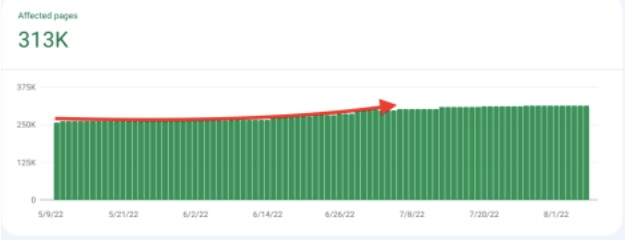
New job pages were not consistently being indexed by Google quickly enough.
Some listings could take days to appear in search results. In certain cases, a job could reach Google only after it was no longer active.
For a recruitment platform, this creates a fundamental SEO challenge:
A job opportunity has value only while it is available.
The objective was therefore not simply to increase the number of indexed pages. It was to reduce the time between a job being published and becoming discoverable through Google.
A Technical SEO Problem With a Technical Constraint
Our initial technical SEO analysis showed that the job pages themselves had a structure that was suitable for crawling and indexing.
The bigger issue was discovery.
The existing XML sitemap did not contain all available job URLs. A conventional approach would have been to generate a complete sitemap containing the active job listings and allow Google to discover them through normal crawling.
But there was an important complication.
Job listings are highly dynamic and short-lived.
A job may be published, remain active for a limited period, and then expire. Waiting for Google to naturally discover and crawl every new URL could mean that valuable indexing time was lost.
There was also an engineering constraint.
DigitalBee Labs did not have access to the InfoJobs website codebase or production database.
That meant we could not simply modify the existing application, change its database queries, or rewrite its sitemap-generation process.
We needed to solve the problem around the existing platform rather than by changing the platform itself.
Changing the Indexing Strategy
Our analysis led us to a different approach.
Instead of relying entirely on Google to discover new job pages through normal crawling, we explored a mechanism for proactively submitting relevant URLs.
Google's Indexing API provided an opportunity to programmatically notify Google about eligible URLs.
The challenge then became:
How do we reliably identify the right URLs every day and submit them efficiently at scale?
We evaluated several possible sources of job data:
- Daily web scraping
- An available data API
- A published job data feed
The options were assessed against several engineering criteria:
- Accuracy and freshness of job data
- Speed of data retrieval
- Processing performance
- Infrastructure requirements
- Load placed on the existing InfoJobs platform
- Ability to isolate the solution from the core application
The objective was to build an indexing workflow that was fast, reliable and minimally intrusive.
The Solution: An Independent Indexing Engine
We selected the existing InfoJobs data feed as the source for the indexing process.
Rather than introducing changes to the main website, we designed an independent batch-processing engine using Python, deployed on Google Cloud.
The workflow was designed around a simple principle:
Identify active and newly published listings → extract their URLs → process them in batches → submit eligible URLs for indexing.
The architecture kept the indexing workflow separate from the existing website and database.
This meant the solution could operate independently without requiring changes to the core InfoJobs application.
The architecture provided several advantages:
- Independent batch processing
- Automated processing of published job data
- Efficient URL extraction
- Controlled submission to Google's indexing infrastructure
- Cloud-based execution
- No modification to the core website
- No direct dependency on the production database
- Minimal impact on existing application infrastructure
The result was more than an SEO script.
It was a dedicated indexing pipeline designed around the specific characteristics of a high-volume, time-sensitive platform.
Engineering Around Constraints
One of the most important parts of the project was working within the constraints of the existing system.
We did not need to:
- Rewrite the existing website
- Modify the production database
- Replace the existing application
- Introduce significant processing into the main web servers
- Depend on changes to the core development team
Instead, we built an independent layer around the existing platform.
This approach reduced implementation risk while allowing the indexing process to evolve independently.
It also demonstrated an important engineering principle:
Good engineering is not always about changing the existing system. Sometimes the better solution is to understand its constraints and build an intelligent layer around them.
SEO Expertise Meets Software Engineering
The project required more than traditional SEO knowledge.
Understanding why pages were not being discovered was only the first step.
The solution required a combination of:
Technical SEO
Understanding crawling, indexing, URL discovery and search-engine behaviour.
Research & Development
Evaluating different approaches to obtaining and processing large volumes of frequently changing URLs.
Software Engineering
Designing a reliable batch-processing system capable of handling thousands of URLs.
Python Development
Building the data-processing and indexing workflow.
Google Cloud
Providing an independent execution environment for automated processing.
This combination allowed us to approach the problem from both sides:
SEO identified the opportunity.
R&D identified the possibilities.
Engineering built the solution.
Cloud technology made it independent and scalable.
From Days to Hours
The results were significant.
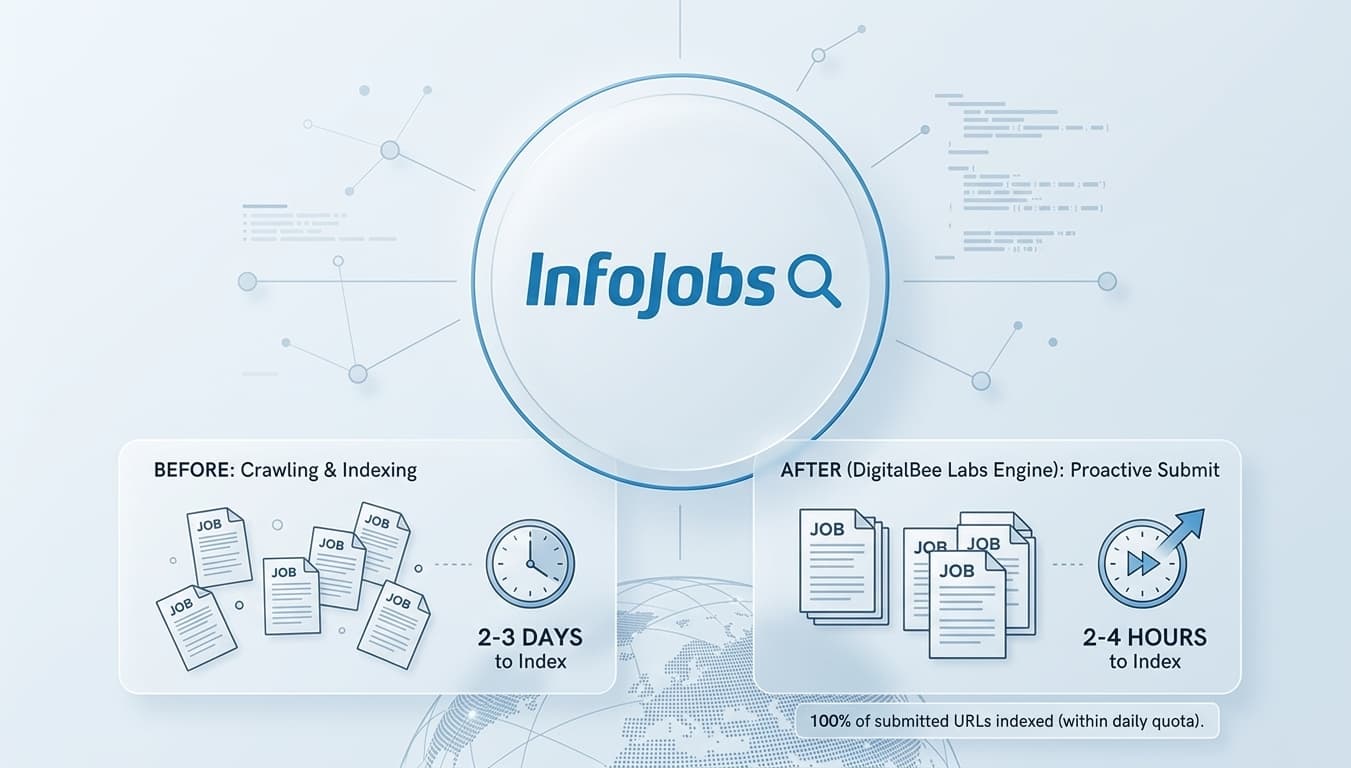
The indexing workflow was able to process and submit up to 2,000 URLs per day within the applicable Google quota at the time of the project.
During measured operation, 100% of the submitted URLs were indexed within that daily processing volume.
More importantly, the time required for new job pages to become discoverable through Google was reduced from days to hours, with the majority of submitted pages being indexed within the same day.
Key results
50,000+
Active job listings
5,000+
New listings per week
2,000/day
Submitted URLs within the measured daily Google quota
100%
Indexing of submitted URLs during measured operation
Hours instead of days
Typical indexing timeframe for submitted pages
The Business Impact
For a recruitment platform, indexing speed is directly connected to the useful lifetime of a job listing.
A job that becomes searchable several days after publication has already lost part of its opportunity to attract candidates.
By significantly shortening the indexing cycle, the solution gave active job listings a much better opportunity to become discoverable while they were still relevant.
The solution also delivered operational benefits:
Cost effectiveness
The indexing process operated independently rather than requiring significant changes to the existing platform.
Processing efficiency
Job data could be processed in batches and prioritised for indexing.
Infrastructure isolation
The solution was separated from the core website, reducing the need to introduce additional processing into the production application.
Scalability
The architecture created a foundation that could be extended for additional data-processing and search-discovery requirements.
Why the Architecture Matters
The most valuable outcome was not simply the improvement in indexing time.
It was the architecture behind it.
InfoJobs had an existing website, existing infrastructure, existing data and existing development constraints.
Rather than requiring a major rebuild, we created a focused technical layer that addressed one specific business problem.
This approach provided three important characteristics:
Decoupled
The indexing engine operated independently from the core application.
Automated
The process could continuously identify and process relevant job URLs.
Extensible
The same architecture could be adapted for other high-volume, frequently changing content.
This is particularly valuable for platforms where content has a limited commercial or operational lifespan.
Beyond InfoJobs
The InfoJobs project demonstrated a broader capability that can be applied beyond recruitment platforms.
Many digital businesses operate websites containing thousands or millions of pages that change continuously.
Examples include:
- E-commerce platforms with constantly changing product catalogues
- Online marketplaces with new and expiring listings
- Real-estate platforms with frequently published properties
- Travel platforms with changing hotels, destinations and offers
- Job portals with newly published and expiring vacancies
- Content platforms publishing large volumes of new pages
For these businesses, search visibility is not only about having good content.
It is also about how efficiently search engines can discover and process important URLs.
DigitalBee Labs can design indexing and search-discovery workflows around the specific architecture and content lifecycle of each platform.
For e-commerce in particular, the broader architecture can support automated URL discovery, prioritisation, sitemap/feed processing and search-engine submission workflows for large and frequently changing product catalogues.
The specific mechanism used depends on the content type, search engine and applicable API requirements. The objective is therefore not to force every business into the same solution, but to engineer the right indexing workflow around the platform.
From a One-Off Solution to a Reusable Capability
What we built for InfoJobs was not simply a one-off indexing script.
It demonstrated a reusable approach to solving search-discovery challenges for high-volume digital platforms.
The same engineering principles can be applied wherever:
- URLs are generated at high volume
- Content changes frequently
- Pages have a limited lifecycle
- Search visibility has a direct business impact
- Traditional crawling is not fast enough
- The existing application should remain largely unchanged
The technology may change from one platform to another.
The engineering principle remains the same:
Find the bottleneck. Understand the constraints. Build around them. Automate what matters.
The DigitalBee Labs Difference
At DigitalBee Labs, we do not separate business problems from technical problems.
The InfoJobs challenge started as an indexing issue.
But solving it required us to understand:
- how the platform generated content
- how users depended on search visibility
- how Google discovered URLs
- how frequently the underlying data changed
- what information was available to us
- what changes could safely be made
- and how to build a solution without disrupting the existing platform
That is where our engineering approach makes a difference.
We combine software engineering, technical SEO, research and cloud technology to solve problems that sit between disciplines.
We do not always start by changing the system.
Sometimes, the best solution is to understand the system deeply enough to know what should not be changed.
From Search Delay to Search Opportunity
The real objective was never simply to index more pages.
It was to make valuable job opportunities discoverable while they were still valuable.
By combining SEO expertise with software engineering and cloud technology, DigitalBee Labs transformed a slow, largely passive indexing process into an automated and independently operated workflow.
The result was a solution that moved indexing from days toward hours, while working within the constraints of an established platform.
And more importantly, it created a technical foundation that can be applied to other businesses facing similar search-discovery challenges.
Listen carefully. Understand deeply. Engineer around constraints. Automate what matters. Deliver measurable outcomes.
That is how DigitalBee Labs turns complex technology challenges into practical business solutions.