The Challenge
As Europe’s premier career network, InfoJobs manages an average of 50,000 active job listings, adding over 5,000 new posts every week. Because employment offers are inherently short-lived entities, rapid search engine indexation is vital to connect employers with candidates before postings expire.
However, InfoJobs faced two major hurdles: an inefficient overall indexing rate and severe crawling delays that often caused jobs to appear on Google Search long after their expiration dates. Traditional XML sitemaps were failing to push time-sensitive URLs fast enough. To make the challenge more complex, our engineering team had no direct access to InfoJobs' underlying codebase or database, preventing direct modifications to their internal sitemap generation logic.
Strategy & Execution
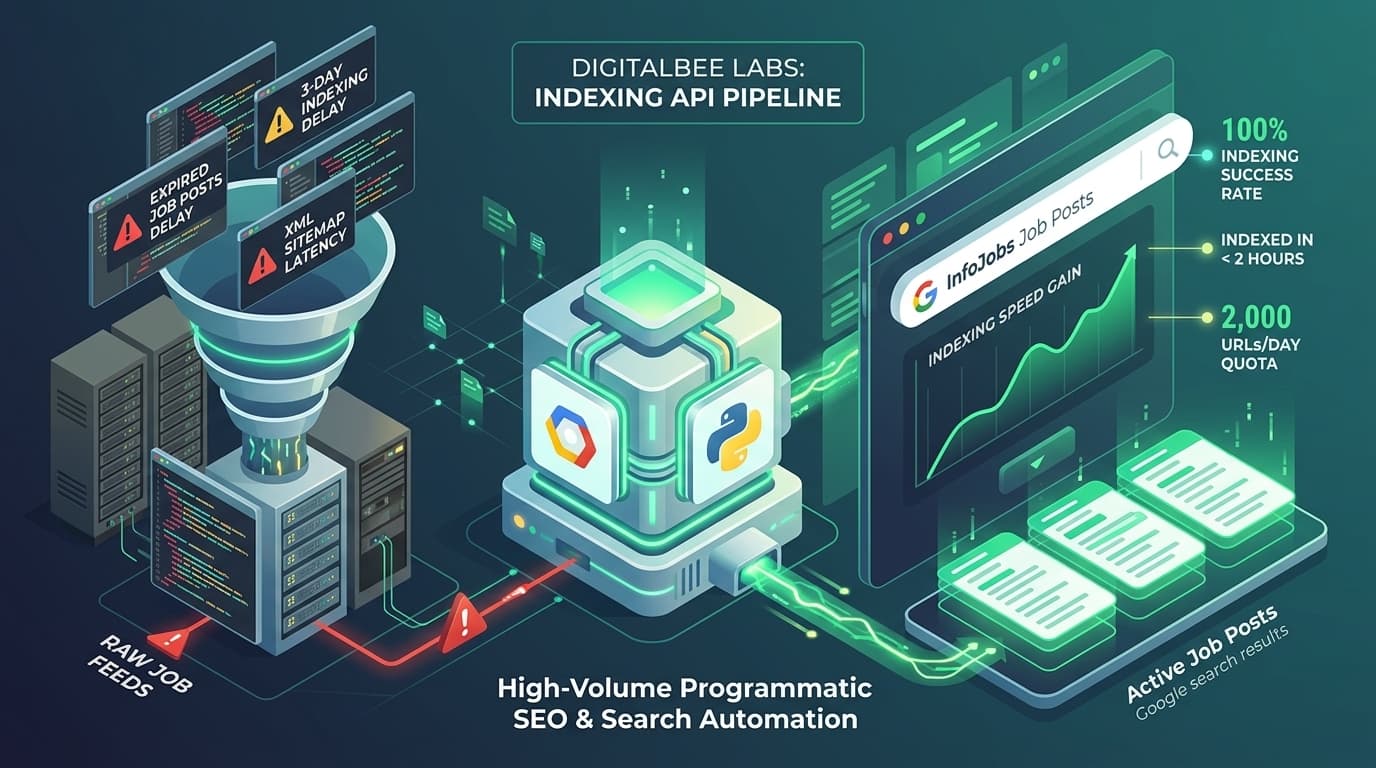
Recognising that standard sitemap crawling was too slow for high-velocity content, DigitalBee Labs paired deep technical SEO expertise with custom software R&D. We shifted the focus from passive discovery to direct, programmatic submission via the Google Indexing API.
To identify active job URLs without querying internal databases or overloading web servers, our engineering team evaluated three ingestion models-web scraping, API polling, and feed processing against criteria including data accuracy, execution speed, system load, and processing performance.
Ingestion Pipeline: We selected InfoJobs' published data feed as the cleanest source, designing an isolated batch-processing engine using Python.
Cloud Architecture: The pipeline was deployed on Google Cloud to automatically process data feeds, isolate new and active listings, and instantly push clean URLs directly to Google's Indexing API.
Decoupled Deployment: By building the engine outside the client's infrastructure, we ensured zero performance drag on InfoJobs’ main web servers or database.
Long-Term Impact
The custom indexing engine completely transformed InfoJobs' organic search speed. Instead of waiting days for Google crawlers to discover new job posts, the majority of listings were indexed and searchable on Google within hours of publication.
By maximising search discovery within the crucial first 24 hours of a job posting, InfoJobs increased candidate volume while maintaining a zero-footprint technical architecture that required no refactoring of their core legacy code.